Welcome back. Aunt Jeanne, who passed away several years ago at age 100, was stellar at completing crossword puzzles. (She would have told me that a 14-letter word for someone skilled at solving or designing crossword puzzles is cruciverbalist.)
My mother, Frances, Jeanne’s older sister, took credit for getting Jeanne started doing crossword puzzles. It began, she related, when they were in the hospital as Uncle Dave, Jeanne’s husband, was dying of cancer. Unlike Jeanne, Frances used to pick up a newspaper, do a few words in the puzzle if she could find a pencil, then move on to news articles she may have missed.
I share this bit of undocumented family history because a recent study compared training with crossword puzzles versus video games for memory functioning (encoding, storing and retrieving information) in older adults with mild cognitive impairment.
Crossword Puzzles vs. Video Games
I was attracted to the study because the last time I paid attention to the general topic was in 2016, for my blog post, Brain Training Games. Then, the conclusion was if you’re playing brain games because you think it improves your cognitive ability to do more than play the games better or accomplish similar tasks, that may be wishful thinking.
This new study was conducted at two sites by researchers affiliated with the New York State Psychiatric Institute and Columbia University Medical Center (lead site) and with Duke University and Duke University School of Medicine.
The researchers randomly assigned 107 participants with mild cognitive impairment to either crossword puzzle training (56) or cognitive games training (51). Participants were average age 71, 58% female and 28% minorities. Training was intensive for 12 weeks, followed by booster sessions up to 78 weeks. Over the course of the study, 7 of 56 crossword-group participants and 9 of 51 games-group participants dropped out.
Web-Based Games and Crosswords
Lumos Labs provided the web-based games and crosswords. Each games session was composed of 6 modules randomly selected from 18 available modules that included memory tasks, matching tasks, spatial recognition tasks and processing speed tasks. Difficulty was scaled over time considering games performance, cognitive area performance and overall cognitive performance. Participants received their overall performance score at the end of each session.
The computerized crosswords were of medium difficulty--comparable to The New York Times’ Thursday crossword puzzles--without performance-based scaling over time. If the puzzle was completed within half of the allotted 30 minutes, a second puzzle was presented. Participants could view the correct answers at the end of the session.
Participants were evaluated in person at five scheduled visits (weeks 0, 12, 32, 52 and 78); research staff conducted three additional phone calls (weeks 20, 42 and 64).
Cognitive Outcomes
The primary measure of cognitive outcome was change from baseline in the 11-item Alzheimer's Disease Assessment Scale-Cognitive (ADAS-Cog). Scores worsened for games and improved for crosswords at 12 weeks and 78 weeks.
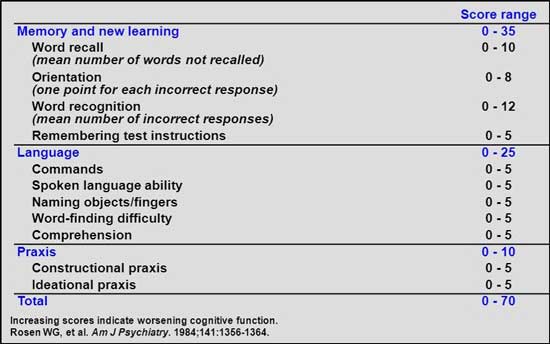 |
| Alzheimer’s Disease Assessment Scale–Cognitive Subscale (ADAS-Cog) 11-Item. (Praxis is an idea translated into action; Constructional praxis is the neurological process by which cognition directs motor action; Ideational praxis is the brain’s ability to develop an idea for action and plan, organize and execute unfamiliar motor actions) (graphic modified from slideplayer.com/slide/7096620/). |
Secondary outcomes included change from baseline in neuropsychological composite score, University of California San Diego Performance-Based Skills Assessment score, and Functional Activities Questionnaire score. The Functional Activities Questionnaire scores worsened more with games than with crosswords at 78 weeks; other secondary outcomes showed no difference.
Magnetic resonance imaging of changes in brain hippocampal volume and cortical thickness were also assessed. Decreases in hippocampal volume and cortical thickness were greater for games than for crosswords.
Wrap Up
The study found crossword puzzles were superior to computerized cognitive games for memory functioning in older adults with mild cognitive impairment. Notably, mild cognitive impairment is associated with high risk for dementia, including Alzheimer’s disease.
While the results were clear, the researchers emphasize the need for replication in a larger trail that includes a control group participating without crosswords or cognitive games. I’ll look forward to those results since I don't do either. Thanks for stopping by.
P.S.
Study of computerized games versus crosswords in NEJM Evidence journal: evidence.nejm.org/doi/10.1056/EVIDoa2200121
Article on study on EurekAlert! website: www.eurekalert.org/news-releases/969320
Alzheimer's Disease Assessment Scale-Cognitive (ADAS-Cog):
www.ncbi.nlm.nih.gov/pmc/articles/PMC5929311/
www.fda.gov/media/122843/download


