28 April 2015

Bracket Fungi Photo Addendum

As promised in the wrap up of last Friday’s blog post, Tree Bracket Fungi, today’s addendum features photos of other tree bracket fungi, all Ganoderma applanatum. There are three tree stumps with fungi along the road and none within sight off the road.

This tree stump, about a quarter mile from the one in last Friday’s blog post, also has multiple tree bracket fungi. I’d bow to a mycologist’s assessment, but none appears new or fresh, as you’ll see in the next six photos.
A closer view of the bracket fungi on one side of the tree stump. The next photo gets closer to the top two.
A view of one tree bracket fungus’s shelf-like attachment to the stump.
A top-down view of two other fungi on the stump. The next two photos view these fungi from different angles.
A more direct view of the two bracket fungi in the previous photo.
Looking up at the two fungi in the previous two photos.
There’s a cluster of bracket fungi near the ground on the other side of the tree stump.
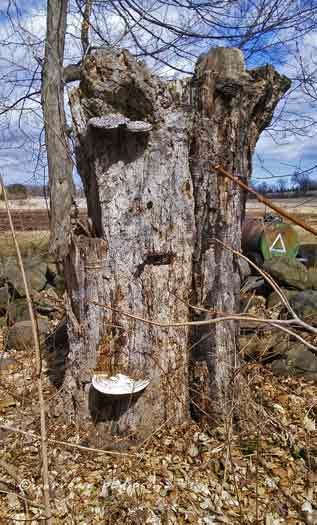
This tree stump with bracket fungi is about midway between the stump pictured above and the one from last Friday’s blog post. Note the white fungus near the base of the stump and the dead bark-colored fungus at the top.
A view of the underside of the dead bracket fungus at the top of the stump in the previous photo. The “art palette” has deteriorated.
A view of the bracket fungus at the bottom of the stump, showing the shelf-like structure (and farm structures in the background).

24 April 2015

Tree Bracket Fungi

Welcome back. Would you like to come along on my research instead of my review of published research?

A tree stump with one large and
smaller tree bracket fungi.
There’s a large growth on a roadside tree stump. It’s the kind of fungus you might want for an art project. Growing up, I used to see them painted or drawn on in shops and people’s camps when we visited the Adirondacks in the summers. Years later, I’d occasionally see them at craft fairs.

I’m not after a new hobby and I’m not partial to that kind of art; but I am curious about, well, everything to do with the fungus and process.

Any interest? If you’re already into mycology--the study of fungi--you’ve nothing to gain. If you come along, though, feel free to correct my mistakes.

What Is It?

I know it’s a fungus growing on a tree and online searching gets me to tree bracket fungus, shelf fungus, shelf mushroom, horseshoe shelf mushroom, conk, artist’s conk, fungal conk, shelf conk and more. From photos and field guides, I’m pretty sure all of the fungi on the tree stump are Ganoderma applanatum


A closer look at the large
tree bracket fungus.
Coming up with the genus and species was easy. Trying to lock down the higher taxonomy sent me on one tangent after another. (That’s often the interesting part of research.) The one botany course I took was long forgotten and whatever it may have taught me regarding fungi classification has changed anyway.

In those days, fungi were still classed as plants instead of having their own kingdom. Much more recently, scientists found through DNA sequencing and cell comparisons that fungi are more like animals than plants. Although the taxonomy is still not fully defined, the best choice for our tree bracket fungi seems to be the Fungi kingdom, the division (or phylum) Basidiomycota, the order Polyporales, the Ganodermataceae family, and again, the Ganoderma genus and Applanatum species.

What Else Do We Know?

Tree bracket fungi are inedible, perennial and parasitic, saprotrophic, or both, living alone or with others, possibly clustered, on dead and dying hardwood trees.


The large tree bracket fungus
with a 12 inch ruler.
They generally grow shelf-like in semi-circular shapes, in sizes from tree to edge of up to about 8 inches--sometimes much bigger obviously. Slicing the fungus in half should reveal layers, one for each year, like tree growth rings.

The fungi’s upper surface is hard, wrinkled or furrowed, and a dull white, gray or brown with a white edge. The bottom surface, the art palette, is white or graying and subject to staining where it’s touched.
 

Each bracket fungus produces an enormous number of spores, which are distributed by wind and may grow new fungi.

Collecting and Preparing the Fungus

Detaching the fungus from the tree is accomplished by cutting with a saw or hatchet if pushing down from the top fails. If art work is planned, matching the art technique with the removal schedule is recommended.

In winter, the fungus is drier and stiffer and in better shape for painting, though further drying is beneficial. In summer, the surface is usually moist and more suitable for pyrography--burning the design with hot pointed instruments--and that can proceed without drying. (My brother had one of those tools to burn names and designs in leather belts. All I remember is touching the tip before it cooled.)

If it’s intended that the tree fungus art will stand on its own, the base should be carved level before it dries further.

Wrap Up

Should you paint, burn or try some other medium? Do you need a primer or protective coating? I’ll leave all that to you. There’s no shortage of information and examples--including bronzed fungi door handles (see Etsy link below).

Me? I’ve learned what I was seeking, and I’d rather see the fungi on the tree stumps than removed for an art project. Come back next Tuesday and I’ll show you some of the others. Thanks for joining me.

P.S.

Tree bracket fungus background:
en.wikipedia.org/wiki/Bracket_fungus
en.wikipedia.org/wiki/Polyporales
www.nrs.fs.fed.us/pubs/gtr/gtr_nrs79.pdf
www.first-nature.com/fungi/~brackets.php
www.mycobank.org
www.edinformatics.com/math_science/living_kingdom_classifications.htm

Tree fungus art--how to and examples:
www.ehow.com/info_8043034_tree-fungus-art.html
www.ehow.com/how_7809772_paint-tree-conks.html
www.cabincreations.net/artist-conks.htm
www.etsy.com/market/tree_fungus

21 April 2015

Office Plants Addendum

If you work in an office alone or with people who don’t object to you landscaping your workspace, you might welcome recommendations for plants. After all, adding plants will likely improve your feelings about work and the work environment (see last Friday’s blog post, Plants at Work).

Since I know something about tropical crops but nothing about office plants, I sought consensus recommendations from sources cited below. I based my selections on two criteria: the plant’s tolerance for low-light conditions and how well the plant removes toxic agents from the air (e.g., benzene, formaldehyde, trichloroethylene).

Although I’ve always been lucky enough to find myself in an office near a window, I thought the more restrictive low-light conditions might be more useful. Air-filtering seemed a worthy criterion, especially when perceived air quality was one measure surveyed in the study described last Friday.

Low-Light Tolerant, Air-Filtering Plants

There are plants, such as cast-iron plant (Aspidistra elatior) and parlor palm (Chamaedorea elegans), that do fine in low light, and there are plants, such as florist's chrysanthemum (Chrysanthemum morifolium), that top the list for filtering air. Here is my honor roll of plants--some that respond to different names--that have been recognized for both low-light tolerance and air filtering. Feel free to suggest others.


Mother-in-Law’s Tongue or Snake Plant, Sansevieria trifasciata. (Photo from multiple websites)
Red-edged Dracaena, Dracaena marginata. (Photo from www.overstock.com/Gifts-Flowers/Bi-color-Dracaena-Marginata-Live-Plant-in-Marble-colored-Planter/5072373/product.html)
Cornstalk or Corn Plant Dracaena, Dracaena fragrans. (Photo from multiple websites)
Peace Lily, Spathiphyllum 'Mauna Loa'. (Photo from multiple websites)
English Ivy, Hedera helix. (Photo from indoor-air-quality-plants.com/english-ivy/)
Devil's Ivy, Pothos or Money Plant, Epipremnum aureum. (Photo from multiple websites.)

P.S.

Office Plants – General:
www.guide-to-houseplants.com/office-plants.html
www.gardeningknowhow.com/houseplants/hpgen/best-office-plants-good-plants-for-the-office-environment.htm
www.bloomberg.com/bw/articles/2014-04-03/best-desk-plants-12-for-the-office
Low-Light Plants:
www.houseplantsexpert.com/easy-to-grow-and-low-light-house-plants.html
www.yankeemagazine.com/gardening-advice-ideas/low-light-houseplants
lifehacker.com/5491870/what-plants-are-cubicle-friendly
www.gardeningknowhow.com/houseplants/hpgen/indoor-plants-that-need-low-light.htm
Air-Filtering Plants:
en.wikipedia.org/wiki/NASA_Clean_Air_Study#cite_note-1
www.mnn.com/health/healthy-spaces/photos/15-houseplants-for-improving-indoor-air-quality/a-breath-of-fresh-air
www.dallasnews.com/lifestyles/home-and-gardening/headlines/20140730-office-plants-that-are-good-for-your-health.ece

17 April 2015

Plants at Work


Welcome back. I know I told you about the problem I had minding the neighbor’s kids’ goldfish (Fish Eyespots), but I don’t think I ever wrote about a government group chief who decided the ambiance of our suite of offices would benefit from tropical fish.

An office aquarium, nicer than
the one we had for a while.
(Photo from multiple websites)
He walked in one morning followed by a logistics officer pushing a dolly on which was a large aquarium--it had to be 4 feet long--a wooden stand and aquarium paraphernalia (all purchased at the group chief’s personal expense). They quickly set everything up in our central space and filled the aquarium with water. The next morning, the group chief arrived with assorted fish in water-filled plastic bags that he emptied into the aquarium. Being a superlative delegator, he enlisted two administrative aides to feed and monitor the fish.

Everyone in the group was pleased and had a favorite fish. As word spread, staff from other offices came by to see the building’s only tropical fish. Visitors on business calls stayed longer than usual to observe, ask questions, give advice and recount fish stories.

All was copacetic until an unknown malevolent force upset the balance of the aquatic ecosystem. Algae flourished on the glass walls; fish began rising to the top, gasping for aquarium rejuvenation. The two administrative aides devoted a soggy 30 minutes, probably longer, to the cleaning--time neither they nor anyone else had for this level of fish sitting. The group chief sadly removed the aquarium.

This adventure came to mind when I saw a study last fall that examined how office employees reacted to the addition of plants (vegetation). Tropical fish are undeniably more mesmerizing than plants, yet the study was still quite interesting.

Study of Leafy Plants in Workplace


An open-space office design with plants.
(Photo from multiple websites)
Maintaining the office environment free of unnecessary embellishments, including plants, allows greater flexibility to modify the space, for example, to vary the number of people or their functions. But is a lean office better than a green office?

Research collaborators from the UK’s Cardiff and Exeter universities, Netherland’s University of Groningen, and Australia’s University of Queensland conducted three experiments in different commercial offices in the UK and the Netherlands to compare the effects of adding versus not adding plants.

The first experiment had volunteer employees work at desks for 3 weeks with or without a view of at least 2 large-leaf plants. Analysis of questionnaire responses from 67 employees (34 lean, 33 green) found those who viewed the plants felt improved concentration, air quality (i.e., “The office has poor air quality”) and subjective productivity (e.g., “ I am happy with my performance lately”) compared to those who did not view the plants.

The second experiment added plants to one office floor but not another, querying the perceptions of volunteer employees after 2 weeks and again after 3.5 months. The responses from 81 employees (21 lean, 60 green) showed those who viewed the plants felt increased workplace satisfaction (e.g., “I feel at home in the office”) and rated air quality higher.

The third experiment randomly assigned volunteer employees to workstations that either had or did not have a view of at least three plants while the employees performed specific information processing and management tasks. The 16 employees who viewed the plants felt increased workplace satisfaction and had a 15% increase in productivity, with no increase in error rate, compared to the 17 employees who did not view the plants.

Wrap Up

Overall, employees in the green workspaces had more positive feelings about their work and environment. Adding plants increased workplace satisfaction, self-reported levels of concentration and perceived air quality, in addition to improving both perceived and actual productivity.


The Pasona office building in Tokyo is probably bursting with positive feelings. (www.archdaily.com/428868/in-tokyo-a-vertical-farm-inside-and-out/) Photo was used in Indoor Farming blog post.
Since government offices occasionally have artificial vegetation, I’d be curious if substituting artificial for real plants would affect the results. Of course, I’d be even more curious if tropical fish were substituted for plants, though I’d warn the researchers to include an algae eater.

Thanks for stopping by.

P.S.

Study in Journal of Experimental Psychology: Applied:
psycnet.apa.org/psycinfo/2014-30837-001/
University of Queensland news release on the study:
www.uq.edu.au/news/article/2014/09/leafy-green-better-lean

14 April 2015

Toes as Piggies Addendum

This Little Piggy (Drawn by artbybambi
 from www.pxleyes.com/drawing-picture/4e3652ed35108/This-little-piggy.html)
Developing last Friday’s blog post, Toe Lengths and You, I couldn’t help thinking of This Little Piggy, the nursery rhyme you recite while wiggling each of your toddler’s toes then tickling his or her foot.

This little piggy went to market/    (wiggle the big toe)
This little piggy stayed home/       (wiggle the next toe)
This little piggy had roast beef/     (wiggle the next toe)
This little piggy had none/             (wiggle the next toe)
And this little piggy cried wee wee wee all the way home!

                                           (wiggle the little toe and tickle the foot)

I’m almost certain my parents played that with me, but I don’t recall ever playing it with my daughter or son. As toddlers, they had more fun reading (e.g., Shakespeare), singing (e.g., polyphonic madrigals) and solving practical math problems (this preceded Common Core guidelines).

This Little Piggy History

All references I found to the rhyme’s origin reported nearly identical information. The earliest known printed version appeared in The Famous Tommy Thumb’s Little Story Book, published in London in 1760; however, the rhyme must have circulated well before that date. Its first line was quoted in a medley, The Nurse’s Song, written around 1728 and included by Allan Ramsay in the fourth volume of The Tea-Table Miscellany, published in 1740.

Although nursery rhymes of that era commonly conveyed historical events or were used to parody royalty or political events, This Little Piggy seems to have been a nursery rhyme pure and simple. With minor variations, the rhyme appeared in many late-18th and early-19th century collections. 

Example Music Rhyme Videos

Forgoing cartoon-type videos of the rhyme, I offer a children’s music version by The Wiggles, joined by Lee Hawkins, and a more adult if abbreviated version by Christina Aguilera, giving her impression of Britney Spears singing the song. The video with Ms. Aguilera, from The Tonight Show with Jimmy Fallon, runs 5 minutes, but This Little Piggy starts about halfway. (Along the way you’ll hear Ms. Aguilera’s spot-on impression of Cher singing the Folger coffee commercial.)


The Wiggles with Lee Hawkins singing This Little Piggy Went to Market. (Photo from www.youtube.com/watch?v=AMsAHD5_TOg)
Christina Aguilera doing musical impressions on Jimmy Fallon’s Tonight Show. (Photo from www.youtube.com/watch?v=uD2nOjV3AaI)
P.S.

Selected background references:
en.m.wikipedia.org/wiki/This_Little_Piggy
mudcat.org/thread.cfm?threadid=69437
alicemfisher.wordpress.com/2011/01/29/this-little-piggy/

10 April 2015

Toe Lengths and You

Welcome back. Having learned about the wealth of information that may be conveyed by the lengths of your fingers--see last Friday’s post, Finger Length Ratio--you are now, of course, wondering about your toes. Do they too provide indications of behavioral, health, sexuality or other significant information?

My search to address this question suggested two bins, research and, for the moment, myths. The latter bin is much fuller, so I’ll empty that first.

Foot Shape Myths


Foot shape and heritage. (Modified
from diagram on multiple websites)
Some believe foot shape identifies heritage (e.g., Egyptian, Roman, Greek, Germanic or Celtic); the premise being that our genome determines certain physical factors and our morphology is heritage dependent. Among the problems with defining such lineages is the complexity that arises with centuries of mixing.

Where it gets fanciful, however, is when foot shapes are linked with personalities. For example:

The Common Foot (aka Roman Foot) belongs to someone balanced and well proportioned, who is typically outgoing and sociable and open to new experiences and cultures.

The Flame or Fire Foot (aka Greek Foot) belongs to the active and creative types, who are enthusiastic about new ideas and people, though they can be impulsive and thus stressed.


Square and stretched foot shapes. (From
www.company.co.uk/beauty/health/)
The Square Foot (aka Peasant Foot) belongs to dependable, practical people, who examine every decision in detail.

The Stretched Foot (no reported aliases, though it looks like a squeezed Egyptian to me) belongs to private individuals with hidden depths, who may be impulsive and change mood often.

Personalities are also linked to foot size, toe positioning, heels and more, which brings me to foot reading.

Foot Reading Toe Myths

Foot reading, not to be confused with acupuncture or alternative medicine’s reflexology, which has its own questions, has reportedly been practiced in India and China for over five millennia. Although different foot characteristics may be taken into account, I’ll stick with toes and even there offer only two examples:


How to measure toe length. (From
www.astrogle.com/palmistry/)
Big Toe - If it’s much longer than other toes, you are clever and creative, though you may have problems focusing and seeing projects through; if it’s shorter, you’re a superb multitasker, who delegates effectively and persuades with charm.

Second Toe – The longer the toe next to the big toe, the more leadership qualities you have, though this can become bossiness; if shorter, you value harmony and are satisfied biding your time.

Toe Length Research


Three studies rose to the top, and one of those was more about fingers than toes.

A 2002 publication from the University of Texas used digital scans of hands and feet to estimate all possible finger and toe length ratios, excluding those with thumbs, from 122 heterosexuals (62 female, 60 male) and 64 gay persons (29 female, 35 male).

The findings regarding finger length ratios were in agreement with those reported in last Friday’s blog post. New and of some interest is that nearly all finger ratios for gays fell between those of heterosexual males and females, though few of the differences were significant.

Toe length ratios were larger than finger length ratios, and gender differences were smaller; however, because of substantial toe arching, the toe lengths estimated from the digital scans were less reliable and conclusions less certain.

The University of Texas study findings, other than those for gays, were replicated with more success in 2010 by University of Vienna researchers with 69 females and 59 males.

Also in 2010, a study from Pennsylvania State University focused on the second toe. As noted in last Friday’s post, the generally accepted cause of different finger length ratios and possibly of behavioral and other differences is prenatal androgen (e.g., testosterone) exposure.

Pursuing evidence of a link between the second toe length and prenatal androgenization, the researcher collected self-reported information from 107 students (70 female, 37 male) on their second toe length and on behaviors and traits previously shown to be related to testosterone and finger length ratios.

Females with longer second toes reported more competitive orientations and physical aggression, while men reported greater exercise frequency. Results for both males and females showed a significant association between longer second toe length and left-handedness but no association with sociosexual or sexual orientation.

Wrap Up

Foot reading and assigning personalities to foot shapes and toes seems akin to what you discover about yourself after opening a fortune cookie. But, hold on. Research on toes may lend credence to some of the observations. If finger length ratios is worthy of research, why not more work on toe length? In any event, thanks for stopping by.

P.S.

Selected articles on foot shape:
amazingbeautifulworld.net/interesting-facts/5-feet-shapes-really-indicate-rootsheritage
www.company.co.uk/beauty/health/what-does-your-foot-shape-feet-say-about-you
brandongaille.com/what-your-foot-says-about-your-personality/
Selected articles on foot reading:
www.astrogle.com/palmistry/foot-reading-basics-tips-secrets.html
www.footreading.com/
www.news.com.au/lifestyle/relationships/graphic-suggests-toe-length-denotes-ancestry/story-fnet0he2-1226758821691
Research investigations:
Univ. of Texas, 2002: www.ncbi.nlm.nih.gov/pubmed/12488115
Vienna Univ., 2010: www.amsciepub.com/doi/abs/10.2466/pms.110.1.33-47
Penn State, 2010: citeseerx.ist.psu.edu/viewdoc/download?doi=10.1.1.187.855&rep=rep1&type=pdf

07 April 2015

Finger Painting Addendum

Pondering an extension of last Friday’s post, Finger Length Ratio, I thought you’d welcome something more, well, colorful. That led me to finger painting. Since my recollection of the topic was limited to artwork hung prominently on our refrigerator when my offspring were in elementary school, my reaction to what I found was WOW!

Before justifying my reaction, I’d better mention that Ruth Faison Shaw introduced finger painting to art education and, in 1931, patented a non-toxic, gelatinous paint that would be safe for children. Adults decided to try it out, and they--finger painting artists--moved on to donning surgical gloves so they could finger paint with oils, acrylics, soft pastels and just about anything in addition to Ms. Shaw’s finger paint.


Zaria Forman’s finger painting, “Greenland #66,” on view at the American Embassy in Switzerland through 2017. Soft pastel on paper. (From www.zariaforman.com/; video of artist’s work:
www.youtube.com/watch?v=aQv_VrMYHRw)
Iris Scott’s finger painting, “Shakin' off the Blues,” paper print of original oil (From twistedsifter.com/2014/06/fine-art-finger-paintings-by-iris-scott/; artist’s website: www.irisscottfineart.com/)
Dennis Velco’s finger painting, “Poppies and Their Buds,” acrylic paint on canvas. (From www.dennisvelco.com/; 1st of 22 videos of artist at work: www.youtube.com/watch?v=nvUbSvUuens&index=4&list=PL64590AA4B7BDD3AF)
The late Jimmie Lee Sudduth’s folk art, finger painting, “The Grimsley House with Tree,” mud and paint on wood. (From www.marciaweberartobjects.com/sudduth.html)
Chuck Close’s “Fanny/Fingerpainting,” oil on canvas, which earlier hung in Smithsonian’s National Gallery of Art. (From www.mymodernmet.com/profiles/blogs/chuck-close-fanny-fingerpainting; www.nga.gov/content/ngaweb/Collection/art-object-page.69637.html)
Paolo Troilo’s finger painting “Carnival #3,” acrylic on canvas. (From www.troilo54.com/; video of the artist describing his work: www.youtube.com/watch?v=sM5W8ntRPxc)
Hanging scroll "Finger Painting of Eagle and Pine Trees" by Gao Qipei (1660-1734), Shanghai Museum. (From commons.wikimedia.org/wiki/File:GaoQipei-FingerPaintingOfEagleAndPineTrees-ShanghaiMuseum-May27-08.jpg)
I’ll end with this painting, because I like it and the strokes and smears are how I remember finger painting. (Painter unknown; from synergysm.com/wpcontent/uploads/2014/05/Fingerpainting_Poster.jpg)
P.S.

Background: en.wikipedia.org/wiki/Fingerpaint
Examples of other artists whose work is not shown here:
www.fingerpainter.com/
yolandasanchezstudio.com/paintings

03 April 2015

Finger Length Ratio

Welcome back. Today I’m going to tell you things about you. To do that I’ll need a number. Please do the following:
2D:4D Finger Length Ratio.
(Photo from multiple websites)

Find a ruler and measure the length of your index finger (aka forefinger), base to tip on the palm side. Label that measurement “2D,” for second digit. (The thumb is 1D.) Now, measure the length of your ring finger. Label that “4D,” for fourth digit. Finally, do a little math. Calculate the ratio 2D:4D by dividing the length of your index finger, 2D, by the length of your ring finger, 4D.

You’ll be amazed how much your 2D:4D finger length ratio conveys about you.

Digit Ratio and Agreeableness

When I first saw that a recent study found men’s 2D:4D ratios signaled the men’s agreeableness with women, I had serious reservations even though the work came from the highly respected McGill University in Montreal.

The McGill researchers had 155 volunteers (78 men, 77 women) spend three weeks completing forms with a checklist of "agreeable" or "quarrelsome" behaviors for every social interaction that lasted at least five minutes with someone of the opposite sex.

Men with smaller 2D:4D ratios (index finger shorter than ring finger) were significantly more agreeable and less quarrelsome toward women than toward men. Those men checked on the order of one-third more agreeable behaviors toward women and one-third fewer quarrelsome behaviors. Women, in contrast, showed no relationship between their finger length ratio and behavior.

Cause for Differences?

Was this phrenology revisited? (Phrenology, you’ll recall, is the pseudoscience that focused primarily on measurements of the human skull to gauge an individual’s strengths and weaknesses.) Nope, it’s real science and the finger length ratio is far from being a new parameter.

Ratio differences were reported in scientific papers in the final quarter of the 19th century--for example, that men and women typically have shorter index fingers than ring fingers, but men’s are generally shorter. If I got it right, however, it took another century before anyone reported a relationship between the ratio and behavior and offered an explanation for why.

A 1983 study of 985 women by a researcher at King’s College in London found that women with 2D:4D ratios less than 1 (index finger shorter) were more likely to describe themselves as “assertive and competitive” than women with 2D:4D ratios greater than 1 (index finger longer). The researcher suggested that the finger length and behavioral differences could reflect the simultaneous effect of prenatal sex hormones on body and brain.

And apparently that’s more or less still the accepted cause. The 2D:4D ratio, like other adult phenotypes, is affected by androgens, such as testosterone, while developing in the uterus. The ratio is thus a measure, albeit rough, for the level of prenatal androgen exposure.

Wrap Up

Over the years, various studies have related 2D:4D ratios with behaviors, health and sexuality. While not all studies had positive results, among many that did are relationships with academic performance, rate of ADHD, anxiety, leadership, sensory perception, risk of prostate cancer, heart disease and alcohol dependency, sperm count and penile length.

The relationships seem better expressed by the right than left hand, suggesting that more than prenatal androgen exposure is involved; and more relationships are men only (not just penile length) than female only.

Overall, it’s an interesting topic with a broad potential reach. Thanks for stopping by.

P.S.

McGill University study in Personality and Individual Differences journal:
www.sciencedirect.com/science/article/pii/S0191886914006400
Articles on McGill and related studies on Science Daily and LiveScience websites:
www.sciencedaily.com/releases/2015/02/150218122110.htm
www.livescience.com/49883-finger-length-in-men.html
King’s College study in Personality and Individual Differences journal:
www.sciencedirect.com/science/article/pii/0191886983900612
Discussion of topic on Wikipedia:
en.wikipedia.org/wiki/Digit_ratio